
Attacks by settlers in the occupied West Bank are increasingly driving the forced displacement of Palestinian communities, with dozens at risk of erasure. Israeli authorities are arming, funding, and granting impunity to the violent settlers responsible for these escalating deadly abuses.
Settler violence spiked in March and April 2026, with killings, including of children, as well as assaults, sexual violence, physical and mental abuse, arbitrary detention, arson, property destruction, and theft. The attacks occurred during the United States and Israel’s war with Iran, but the rising trend has been clear since the current government took office in December 2022.
‘The Israeli government and the settlers share the same goal of maximum land and minimum Palestinians, with the authorities not only failing to stop settler violence, but actively enabling it,’ said Sarah Sanbar, acting Israel and Palestine researcher at Human Rights Watch. ‘Settlers shoot, attack, and expel Palestinians from their land, and the state provides the weapons, the legal cover, and the budget to do it.’
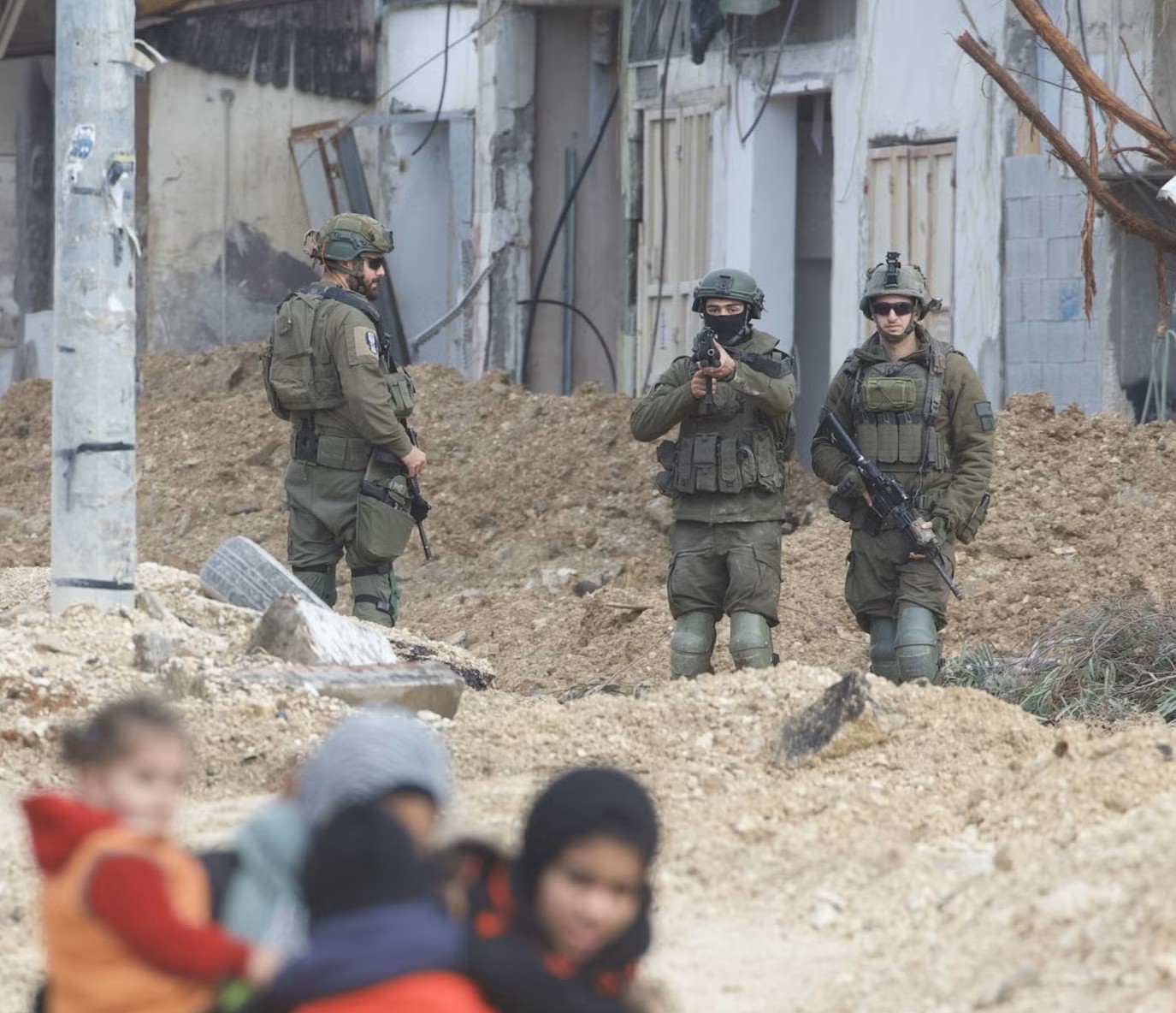
In April and May, Human Rights Watch investigated settler attacks in seven Palestinian West Bank communities: Al-Mughayyir, Mikhmas, and Taybeh, in Ramallah governorate; Jalud and Qaryut, in Nablus governorate; and Khirbet Humsa and Muarrajat East, in the Jordan Valley. Armed settlers, at times acting alongside Israeli army units or with soldiers standing by yet failing to intervene, attacked Palestinian residents and property, contributing to a pattern of forced displacement.
Human Rights Watch spoke to 20 witnesses and reviewed videos that witnesses filmed and CCTV footage of multiple incidents. The Israeli military has not replied to questions from Human Rights Watch about the attacks.
People interviewed reported organized attacks targeting Palestinians’ livelihoods and food security by restricting access to grazing land and water, stealing or killing livestock, and destroying or burning agricultural fields and crops. As a result, many either sold their livestock, often at a loss, or had to bear the cost of grain to feed them at home.
Human Rights Watch found that attacks increasingly target the area of the West Bank under joint Israeli-Palestinian Authority security control, known as “Area B” under the 1995 Oslo II Accords.
The attacks and lack of state protection have created a coercive environment that leaves many Palestinians saying they have no choice but to leave their homes.
‘I have known war in this region for all my life, but never like this,’ said Um Muhammad Muammar, 72, a resident of Qaryut whose two sons were killed by settlers. ‘My sons’ children are now fatherless; their wives are now widows. What more can we say?’
According to the United Nations Office for the Coordination of Humanitarian Affairs (OCHA), more Palestinians were forcibly displaced by settler attacks, demolitions, and evictions in the first four months of this year than the whole of 2025. OCHA has documented an average of 6.6 settler attacks per day that resulted in casualties, property damage, or both, higher than any year on its record.
While the Israeli military remains responsible for the majority of killings in the West Bank, fatalities attributed to settlers have risen sharply. OCHA recorded at least 15 Palestinians, including two children, killed by settlers as of July 24, putting 2026 on track to surpass OCHA’s previous record of 16 such killings set in 2023.
It found that settler violence has completely or partially displaced 107 communities comprising 5,900 Palestinians since January 2023. The Israeli military expelled another 32,000 Palestinian refugees from their West Bank homes in January 2025, essentially emptying the Jenin, Tulkarem, and Nur Shams camps. The E1 settlement project east of Jerusalem, for which the government opened a new construction tender on August 18, 2026, would forcibly displace over 18 more Bedouin communities in the area.
Settlers responsible for displacing Palestinians operate with the financial, material, and legal backing of the Israeli state. In March, the Times of Israel reported that the government had approved about 50 million shekels (about US$16 million) for illegal settlement outposts, funding that has been used for all-terrain vehicles, night-vision goggles, and drones that settlers use to harass Palestinian communities. According to Amnesty International, the Ministry of Settlement and National Missions’ budget has increased 122 percent under the current government.
Israeli authorities fail to prosecute settlers for violence against Palestinians, effectively granting them impunity. At the end of 2025, Yesh Din, an Israeli human rights organization, reported that of the hundreds of cases it had documented since 2005, only three percent had resulted in convictions. In November 2025, the Israeli news outlet N12 News reported a 70 percent drop in police cases against settlers for attacking Palestinians since Itamar Ben-Gvir became National Security Minister in 2022, despite the unprecedented rise in such attacks since then. Just one Israeli has been charged for killing a Palestinian in the West Bank since 2019, according to the Guardian.
The line between settlers and state security forces is deliberately blurred, making it difficult to distinguish settlers from soldiers. Following the October 7, 2023 attacks on southern Israel by Palestinian armed groups, the Israeli military called up 5,500 West Bank settlers who are army reservists and assigned them to West Bank ‘regional defense battalions.’ These settler-soldier units act with wide autonomy, advancing settler objectives while holding full military authority and committing abuses against Palestinians with impunity.
At the same time, the National Security Ministry formed civilian ‘rapid response squads’ in settlements and gave them special policing powers, uniforms, and weapons. Ben-Gvir also loosened licensing requirements for firearms, in some cases personally overseeing the distribution of rifles to settlers.
Settler violence and the displacement it causes are both a manifestation of and a vehicle for Israel’s expanding illegal settlement enterprise. In July 2026, Israeli Defense Minister Israel Katz told Channel 7 News that his government had approved the establishment of 104 new settlements since taking office, nearly doubling the total number from 127 to 231. During the war with Iran, the Israeli cabinet secretly approved what i24 News stated was the largest single settlement expansion in the history of the settlement enterprise, comprising 34 settlements, 10 of which were preexisting outposts that were retroactively ‘legalized’ under Israeli law.
These outposts, which often serve as launching pads for attacks, are illegal under international humanitarian law. Lacking formal permits from the Israeli government, they are also considered illegal under domestic law, though the Israeli government frequently retroactively ‘legalizes’ them. Their ‘legalization’ under domestic law has no bearing on their continued illegality under international humanitarian law.
Under the current Israeli government, settlers have established 248 new outposts in the West Bank, 65 in 2026 alone as of August 1, according to Israeli group PeaceNow. Often serving as precursors to larger settlements, these outposts—and their retroactive ‘legalization’ under domestic law—push the frontier of settlement expansion and the appropriation of Palestinian land. Katz told Channel 7 News that his government had ‘legalized’ about 160 outposts during its tenure.
Israeli organizations Kerem Navot and PeaceNow reported in July that these outposts currently effectively control more than 1 million dunams (100,000 hectares) of land—approximately 18 percent of the West Bank—four times what they controlled before the current government took office.
Article 49 of the Fourth Geneva Convention prohibits an occupying power from forcibly transferring, displacing, or deporting the civilian population of an occupied territory in whole or in part. The only exception is temporary evacuation of an area if necessary for the security of the population or imperative military reasons. The International Committee of the Red Cross’s 2025 Commentary on the Fourth Geneva Convention notes that forcible transfers can be indirect when a party does not expressly order or is not directly involved in the deportation, ‘but commits violations of international humanitarian law or human rights law with the effect to cause the population to leave.’ Article 49 also prohibits the occupying power from transferring its own civilian population into the territory it occupies.
The evidence shows that Israel has failed to uphold its obligations to protect against, prevent, investigate, and prosecute acts of violence against the occupied population and has further enabled this violence by continuing to provide material support for settler groups responsible for abuses against Palestinians. The reallocation of displaced Palestinians’ land for illegal settlements indicates that this displacement is not temporary and cannot be considered permissible evacuations under the Fourth Geneva Convention.
Other countries should act to prevent further atrocities across the Occupied Palestinian Territory, including by imposing targeted sanctions on those implicated in ongoing grave abuses, suspending arms transfers to Israel, banning trade with illegal settlements, considering suspending preferential trade agreements with Israel, and supporting the International Criminal Court and its ongoing investigations, including by executing its arrest warrants.
‘The impunity Israeli authorities accord settlers stems directly from the free pass Israel’s allies and donors have granted it,’ Sanbar said. ‘Accountability starts with the settlers committing crimes but doesn’t end there. Israel and the governments that give it a blank check share responsibility and should be held to account.’
In July 2024, the International Court of Justice found that Israel’s occupation of Palestinian territory is unlawful and that Israel is in breach of the prohibition of racial segregation and apartheid. The court found that Israel has systematically failed to prevent or punish settler attacks on Palestinians’ life and bodily integrity, concluding that settler violence, alongside land confiscation and resource deprivation, has contributed to the creation of a coercive environment.
The court further found that Israel’s policies and practices often leave little choice to Palestinians living in Area C—under Israeli security and civil administration—but to leave their area of residence, and that Israel’s practices are contrary to the prohibition of forcible transfer. The court found Israel has an obligation to evacuate all settlers in the West Bank including East Jerusalem, allow displaced Palestinians to return to their homes, and provide them with reparations.
Human Rights Watch has previously found that Israeli authorities intentionally caused the massive, deliberate, and long-term forced displacement of Palestinian civilians in both Gaza and the West Bank, amounting to ethnic cleansing, war crimes, and crimes against humanity. In both cases, senior Israeli officials have declared their aim to expel and keep Palestinians out of parts of Gaza and the West Bank.
Human Rights Watch has previously called for forced displacement and prevention of the right to return committed by Israeli authorities in Gaza to be investigated as a crime against humanity. Human Rights Watch has called for investigating the military officials Maj. Gen. Avi Bluth, Lt. Gen. Herzi Halevi, Lt. Gen. Eyal Zamir, Prime Minister Benjamin Netanyahu, Defense Minister Israel Katz, and Defense Minister Bezalel Smotrich for individual criminal responsibility, including as a matter of command responsibility, for war crimes and crimes against humanity committed in the context of the forced displacement of the Palestinian population in the West Bank.
Human Rights Watch is an international non-government organisation headquartered in New York City that investigates and reports on human rights abuses around the world. This is its report titled ‘West Bank: Israel-Backed Settler Violence Drives Displacement‘ © 2026 by Human Rights Watch, published on 20 August 2026. Republished under a Creative Commons License. See the full report for more details on particular attacks.