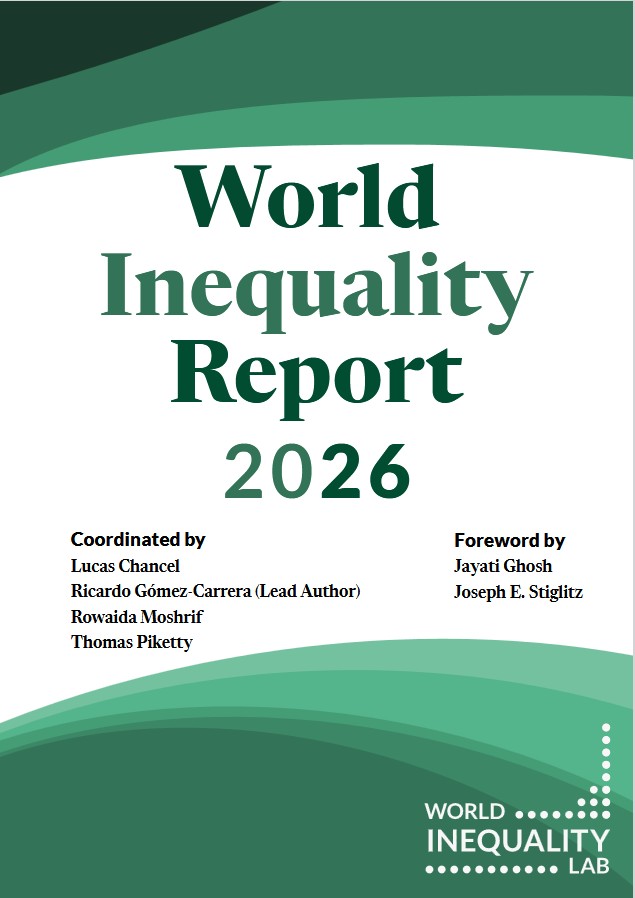
Since 2018, the World Inequality Reports have become a landmark in global public discussions on inequality. They have reshaped how citizens, policymakers, and scholars understand the scale, causes, and consequences of inequality in today’s world.
This World Inequality Report, like its predecessors, is the result of an extraordinary collective effort. Drawing on the work of more than 200 researchers across all continents, affiliated with the World Inequality Database, it offers essential insights into how our economies function—and provides pointers on how they can function more fairly.
This 2026 edition comes at a critical time. Around the world, living standards are stagnating for many, while wealth and power are even more concentrated at the very top. Independent research is under threat in places where academic freedom once seemed secure. These developments are connected: rising inequality undermines trust, weakens our democracies, and fuels discontent.
The data presented here are striking. The richest 10% of the global population own close to three-quarters of all wealth, while the poorest half hold barely 2%. Fewer than 60,000 multi-millionaires now control three times more wealth than half of humanity combined. Within most countries, the bottom 50% rarely possess more than 5% of national wealth.
The report also shows that the wealthiest contribute disproportionately little to public finances. Effective tax rates climb for most of the population but fall sharply for billionaires and centi-millionaires. This not only undermines tax justice; it deprives societies of the resources needed for education, healthcare, and climate action.
Across its chapters, the report explores how inequality manifests far beyond wealth, in gender, opportunity, or climate. As shown in Chapter 4, women capture just over a quarter of global labour income, even though time use surveys suggest that they work for longer hours than men, often in an unpaid form. If unpaid domestic and care work is included, they earn only about one-third as much per working hour as men. Inequality of opportunity is also staggering: while the per capita income gap between Europe and Sub-Saharan Africa is roughly tenfold, the gap in public education expenditure per school-age student is nearly thirty-fivefold.
Today’s inequality of opportunity fuels tomorrow’s inequality of outcomes. Climate inequality underscores this further. According to Chapter 6, the richest 10% of individuals account for 77% of the carbon emissions associated with private capital and 47% of consumption-related emissions, while the poorest half contribute just 3% (and 10% of consumption-based emissions). Climate change also hits the poor hardest: measured relative to their income, the bottom 50% bear about 75% of global climate-driven income losses. These figures make clear that inequality lies at the heart of today’s social and environmental crises.
Deep structural imbalances persist between the Global North and South. As detailed in Chapter 5, each year, poorer nations transfer more than one percent of world GDP to richer ones through debt service, profit repatriation, and financial flows—this is approximately three times more than development aid flowing in the opposite direction.
The result is a system where resources extracted from labou and nature in low-income countries continue to sustain the prosperity and the unsustainable lifestyle of people in high-income economies and rich elites across countries. These patterns are not accidents of markets. Rather, they reflect the legacy of history, but even more the functioning of institutions, regulations, and policies—all of which are related to unequal power relations that have yet to be rebalanced.
History, experiences across countries, and theory all show that today’s extreme inequality is not inevitable. Progressive taxation, strong social investment, fair labour standards, and democratic institutions have narrowed gaps in the past—and can do so again. The World Inequality Report provides the empirical foundation and intellectual framework for what can be done.
In November 2025, together with a group of inequality scholars, we were invited by the President of South Africa, chair of the G20, to propose new ways to tackle global inequality. We called for an International Panel on Inequality—an independent body of experts, supported by governments, bringing together the work of researchers across the world to track inequality worldwide, consider the drivers of inequality, and provide objective, evidence-based recommendations for policymakers. We cannot address today’s inequalities effectively without such a knowledge base. The World Inequality Lab is an important example of such work and the way forward.
This report sets a high standard for evidence-based policy making. It reminds us that inequality is not destiny, but choice—and that with serious, independent research, and political will, fairer and more sustainable societies are within reach.
Jayati Ghosh taught economics at Jawaharlal Nehru University, New Delhi, for nearly thirty-five years. She is now a professor of economics at the University of Massachusetts. Joseph E. Stiglitz,is a Nobel laureate in economics and a professor of finance and business at Columbia University. This is the foreword of the World Inequality Report 2026, by Chancel, L., Gómez-Carrera, R., Moshrif, R., Piketty, T., et al., World Inequality Lab. wir2026.wid.world, and is republished under Creative Commons License.
Click here to read the full report.